
A new AI-powered technology is locating sperm cells in men who were told they had none – and giving couples who have been trying for years another chance at having children.
It was early November 2025 when Penelope received a call whilst driving home from work in New Jersey in the US. It was her doctor, phoning with news she had been longing for. After an agonising two and a half years of trying, Penelope was finally pregnant.
After many tests, Penelope and her husband Samuel had learned that he had Klinefelter syndrome, a genetic condition that affects males who are born with an extra X chromosome, often not diagnosed until adulthood. Most people with Klinefelter syndrome produce little or no sperm in their ejaculate, a condition known as azoospermia. About 10% of infertile men experience azoospermia.
Bursting with joy and disbelief, Penelope waited until Samuel (both their names have been changed to protect their identity for privacy reasons) returned home that evening to share the news.
“His face was just a wave of emotion,” she says. “He cried… just to finally get to that point, because it took so much effort, time and research. And the fact that we only had one embryo, and it worked, we were just over the Moon.”
Their pregnancy was only made possible thanks to a new technique, known as the Star (Sperm Track and Recovery) system, developed by Columbia University to trace sperm in men with azoospermia. The system uses artificial intelligence to help identify and locate the few “hidden” sperm that men with this condition can have.
“I was scared. I thought that I wasn’t going to be able to have my own kid, which is a really big part of my life,” says Samuel, who was told he had a 20% chance of having a biological child. “And that was a big slap in the face.”
Infertility affects millions of people worldwide, with around one in every six people of reproductive age experiencing problems with getting pregnant at least once in their lifetime. Male infertility is a contributing factor in up to 50% of cases and 1% of all men are azoospermic.
This means potentially millions of men worldwide have sperm counts so low that their individual spermatozoa are so hard to find that they are considered to be azoospermic. But the power of AI to find these hidden sperm could offer hope to those hoping to become parents.
You’re trying to find that really rare sperm in a sea of all this other debris and cell fragments – Zev Williams
At the end of last year, after five years in development, the first baby to be born using the Star system allowed a couple who had battled with infertility for almost two decades to finally have a child. It’s a moment Zev Williams, director of Columbia University Fertility Center, and his team remember well.
“Everyone was just jumping up and down with joy,” he says. “There are so few things where the reward for all the effort that was put into it is something as wonderful and special as this. Now there’s a baby girl and hopefully, God willing, many, many more.”
Since the arrival of the first Star baby, the technology has been used regularly at the fertility centre, with the waiting list of people hoping to conceive growing to hundreds from all around the world. Based on the latest 175 patients to have used the technology, Williams says they are finding sperm in just under 30% of cases. These are individuals who had otherwise been told that they had no chance of having a baby using their own sperm.
In further tests, Star was able to find 40 times more sperm than a manual search by a trained human technician, according to Williams.
Usually a semen sample has tens of millions of sperm per millilitre. A tiny droplet from a sample is examined under a microscope so sperm count can be estimated, while also looking for whether the sperm are moving and healthy. But in azoospermic samples, only a single sperm might be present in the entire sample – although in some cases there are none. Sifting through the sample, one tiny drop at a time, is impractical.
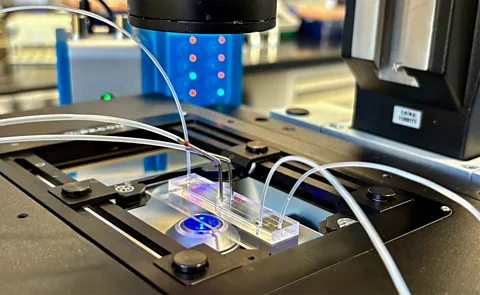
Williams hit on the idea for the Star system in 2020 after reading about how AI is being used to find new stars.
Modern telescopes produce an overwhelming amount of data of the night’s sky that is impossibly time consuming for human astronomers to analyse for objects that haven’t been seen before. But using machine learning algorithms can do this work in minutes.
“The picture of the sky was very reminiscent of what we’re looking for, and what we see in men who are told they have no sperm,” says Williams. He began to ponder whether it would be possible to apply such technologies to identify and isolate sperm in the same way.
He and his team were already using a high-powered imaging technology that could be used to scan the sample. The challenge was to analyse hundreds of images per second in real time to detect and extract any sperm that can be found.